
hs-CRP and Chronic Inflammation Tracking Using At-Home Blood Tests: What the Research Actually Shows
I used to tell everyone in my longevity network to get their hs-CRP checked once a year at their annual physical. I don’t recommend that anymore. A single annual snapshot, taken in a clinical setting after a stressful commute and a bad night’s sleep, can be almost meaningless — and for years I was letting that number quietly reassure people who had real, smoldering inflammatory problems. What changed my mind was looking more carefully at how hs-CRP actually behaves over time, and recognizing that the real signal is in the trend, not the single data point. Serial at-home blood testing, done consistently under comparable conditions, gives you something an annual lab panel simply cannot.
What hs-CRP Actually Measures — and What It Doesn’t
hs-CRP is a high-sensitivity assay of C-reactive protein, a hepatic acute-phase reactant synthesized in response to pro-inflammatory cytokines — primarily IL-6 and TNF-alpha. It detects concentrations as low as 0.3 mg/L, well below the threshold of standard CRP assays, which makes it sensitive enough to flag the low-grade, subclinical inflammation now associated with atherosclerosis, metabolic syndrome, neurodegeneration, and accelerated biological aging.
The data suggests that hs-CRP below 1.0 mg/L is considered low cardiovascular risk, 1.0–3.0 mg/L is intermediate, and above 3.0 mg/L is high — per American Heart Association stratification. But these thresholds were derived from population studies, not individual physiology.
What the marker cannot tell you is where the inflammation is coming from. Visceral adiposity, gut permeability, periodontal disease, sleep apnea, and occult infections can all push the number up. A number alone, without context, is a hypothesis, not a diagnosis.
That distinction matters enormously when you’re making intervention decisions.
Why Chronic Low-Grade Inflammation Is the Longevity Problem Nobody Fixed
The concept of “inflammaging” — the gradual, sterile, low-grade inflammatory state that accumulates with biological age — has been supported by longitudinal cohort data for over two decades, including the InCHIANTI study (Ferrucci et al., 2005), which tracked over 1,000 Italian adults and found that elevated hs-CRP at baseline was independently associated with accelerated functional decline, even after adjusting for age and chronic disease burden. The mechanistic picture has since become clearer: senescent cells secrete a senescence-associated secretory phenotype (SASP) that chronically stimulates CRP production, creating a feedback loop between cellular aging and systemic inflammation.
The counterintuitive finding is that many individuals with hs-CRP values in the “intermediate” range — between 1.5 and 2.5 mg/L — show no overt symptoms. No joint pain. No obvious fatigue. No clinical flags. This is precisely the zone where early intervention is most tractable, and where most people never look.
When you break it down, chronic low-grade inflammation isn’t a disease state; it’s a physiological trajectory. The question isn’t whether your hs-CRP is elevated today, but whether it’s been drifting upward over the past 18 months.
Trajectory is everything. A single number tells you where you are; a trend tells you where you’re going.
hs-CRP and Chronic Inflammation Tracking Using At-Home Blood Tests: The Case for Serial Monitoring
The emergence of consumer-facing at-home blood testing platforms has meaningfully changed the feasibility of serial hs-CRP monitoring. Companies offering finger-prick dried blood spot (DBS) or venous draw kits now allow individuals to test every four to eight weeks, under standardized morning conditions (fasted, pre-exercise, pre-caffeine), generating longitudinal datasets that are far more informative than annual clinical labs. A 2021 validation study published in Clinical Chemistry demonstrated that DBS-derived hs-CRP values showed strong concordance with venous plasma values (r = 0.94), supporting the analytical credibility of this approach for trend monitoring.
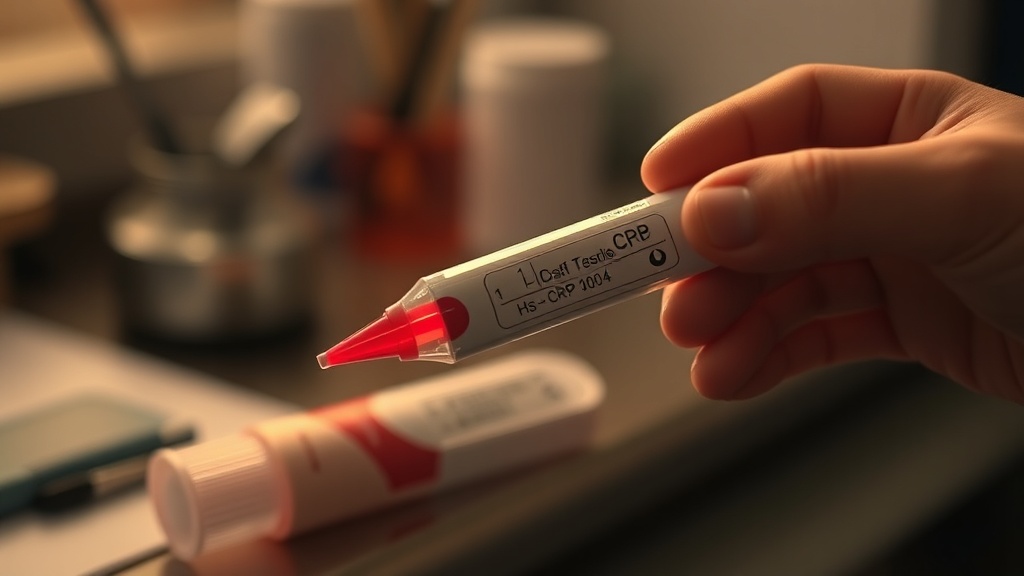
Standardization of testing conditions is non-negotiable. hs-CRP can spike transiently after vigorous exercise, acute psychological stress, alcohol consumption, or even a mild upper respiratory infection. Testing on Monday morning after a weekend of poor sleep and drinking will produce a number that reflects your weekend, not your baseline inflammatory biology.
The practical protocol I use personally: test every six weeks, fasted, same time of morning, no exercise within 24 hours, no illness within two weeks. After three data points, you have a preliminary trend. After six, you have actionable signal.
At-home testing platforms focused on longevity metrics — several of which now include hs-CRP alongside lipid panels, HbA1c, and hormonal markers — are making this kind of systematic self-monitoring accessible to non-clinical populations for the first time. For a broader look at how serial biomarker tracking fits into a structured longevity protocol, the work being done in longevity architecture frameworks is worth exploring in depth.
Most guides won’t tell you this, but: the at-home testing category still has meaningful variation in laboratory quality. Not all DBS kits send samples to CLIA-certified labs. Before committing to a platform, verify the lab certification and ask specifically whether their hs-CRP assay is ISO 15189 accredited or CLIA-waived. An unvalidated assay generating spurious trends is worse than no data at all.
Interpreting Your hs-CRP Trends: Signals That Should Prompt Action
Interpreting serial hs-CRP data requires distinguishing signal from noise. Intra-individual biological variability for hs-CRP is approximately 20–30% (as quantified by coefficient of variation studies), meaning a single jump from 1.2 to 1.8 mg/L may fall within normal physiological fluctuation. The threshold that warrants serious attention is a sustained upward trend across three or more serial measurements, or any single reading above 3.0 mg/L confirmed by repeat testing, particularly in the absence of an obvious acute stressor.
Statistically, individuals with hs-CRP consistently above 2.0 mg/L have roughly twice the cardiovascular event risk compared to those below 1.0 mg/L, per the JUPITER trial data (Ridker et al., 2008, NEJM), which enrolled nearly 18,000 apparently healthy adults. This association held even in individuals with low LDL-cholesterol — a finding that helped establish hs-CRP as an independent cardiovascular risk biomarker.
On closer inspection, the most actionable signal is often a chronic plateau in the 1.5–2.5 mg/L range that fails to respond to lifestyle modifications. That pattern frequently points to identifiable root causes: untreated sleep-disordered breathing, subclinical gut dysbiosis, or persistent visceral adiposity — all of which have established mechanistic links to hepatic CRP production via IL-6 signaling.
A rising trend is a conversation to have with your clinician, not a reason to self-prescribe anti-inflammatory supplements.
Evidence-Based Interventions That Move hs-CRP Downward
The intervention literature on hs-CRP reduction is substantial, though effect sizes vary considerably by baseline status and intervention type. A 2019 meta-analysis in Nutrients (Mazidi et al.) pooling 72 randomized controlled trials found that omega-3 fatty acid supplementation (≥2g EPA+DHA daily) reduced hs-CRP by a mean of 0.41 mg/L (95% CI: 0.14–0.68) in populations with elevated baseline values. Mediterranean dietary patterns showed comparable reductions in the PREDIMED trial (Estruch et al., 2013), with the olive oil arm achieving approximately 0.5 mg/L reduction over five years.
The underlying reason is that these interventions operate on multiple inflammatory pathways simultaneously — reducing arachidonic acid substrate, modulating NF-κB signaling, and improving gut microbiome composition — rather than targeting a single cytokine, which likely explains their durability compared to pharmacological single-target approaches.
Exercise deserves specific mention. The JUPITER trial evidence and subsequent mechanistic work confirm that regular moderate-intensity aerobic activity (150+ minutes per week) is associated with clinically meaningful hs-CRP reductions, with effect sizes in the 0.3–0.8 mg/L range in sedentary populations at baseline. Resistance training shows smaller but additive effects.
What doesn’t work reliably: taking a handful of anti-inflammatory supplements while maintaining poor sleep, high visceral fat, and chronic psychological stress. The data on isolated supplement interventions in otherwise high-inflammatory-load individuals is consistently disappointing.
Unpopular opinion: most people tracking hs-CRP would get more value from an eight-week sleep optimization protocol than from any supplement stack currently marketed for inflammation.
At-Home Testing Platforms: What to Look for and What to Ignore
The consumer at-home blood testing market has expanded rapidly, with platforms now offering hs-CRP as part of multi-biomarker panels targeting longevity, hormonal health, metabolic function, and cognitive resilience — areas including brain fog, energy, and inflammation that are increasingly central to both biohacking communities and clinical preventive medicine. Evaluating these platforms requires attention to four key factors: analytical validity of the assay, laboratory accreditation, turnaround time (which affects monitoring cadence), and whether results are accompanied by clinician interpretation or contextualized reference ranges rather than raw numbers in isolation.
Turnaround time matters more than most people realize. A 10-day lag between sample collection and results makes it difficult to correlate your hs-CRP reading with specific lifestyle exposures from that testing window. Platforms with 3–5 day turnaround significantly improve the interpretive utility of serial data.
The data suggests that panels combining hs-CRP with metabolic markers (fasting insulin, HbA1c) and lipid subfractions give meaningfully richer context than hs-CRP alone. Inflammation without metabolic context is still a hypothesis.
Choose a platform that treats you as someone who can handle real data, not one that obscures values behind vague traffic-light scoring.
Summary Table: hs-CRP Serial Monitoring at a Glance
| Parameter | Detail |
|---|---|
| Low risk threshold | <1.0 mg/L |
| Intermediate risk | 1.0–3.0 mg/L |
| High risk / action threshold | >3.0 mg/L (confirmed on repeat) |
| Recommended testing frequency | Every 6–8 weeks for trend data |
| Minimum data points for trend | 3 measurements (6 for confidence) |
| Intra-individual variability (CV) | ~20–30% |
| DBS-plasma concordance | r = 0.94 (2021 validation study) |
| Most impactful lifestyle intervention | Sleep optimization + aerobic exercise |
| Key confounders to avoid at testing | Acute illness, vigorous exercise, alcohol within 24–48h |
| Lab standard to verify | CLIA-certified or ISO 15189 accredited |
Frequently Asked Questions
How often should I test hs-CRP at home to get meaningful trend data?
For longitudinal trend monitoring, testing every six to eight weeks under standardized conditions (fasted, pre-exercise, no illness within two weeks) is sufficient. Three consistent data points establish a preliminary trend; six provide enough statistical confidence to distinguish a genuine directional shift from biological noise. Testing more frequently than monthly adds cost without meaningfully improving trend resolution, given hs-CRP’s intra-individual variability of approximately 20–30%.
Can a single high hs-CRP reading confirm chronic inflammation?
No. A single elevated reading is a signal to investigate, not a diagnosis. hs-CRP rises acutely in response to infection, intense exercise, alcohol, psychological stress, and poor sleep — all transient exposures that don’t reflect chronic inflammatory status. Chronic inflammation is defined by sustained elevation across multiple serial measurements, taken under standardized baseline conditions. Always confirm an unexpected high reading with a repeat test before drawing clinical conclusions.
Are at-home hs-CRP tests as accurate as clinic lab tests?
Dried blood spot assays from CLIA-certified laboratories have demonstrated strong analytical concordance with venous plasma hs-CRP (r = 0.94 in recent validation data). The key variable is laboratory quality — not all at-home platforms use accredited labs. Before using any at-home service for serial monitoring, verify the specific laboratory’s accreditation status. When accreditation is confirmed, at-home DBS testing is sufficiently accurate for trend monitoring in non-clinical populations, though not equivalent to hospital-grade clinical chemistry for diagnostic decision-making.
The Open Question
Serial hs-CRP monitoring through at-home blood testing represents one of the most cost-accessible, evidence-supported tools available for longitudinal inflammation surveillance. The barrier is no longer analytical — the assays work. The barrier is behavioral: testing consistently, under controlled conditions, and resisting the urge to over-interpret individual data points. When you bring that discipline to the data, hs-CRP trend monitoring becomes genuinely useful for identifying physiological drift years before it becomes clinical disease.
The harder question — the one I keep coming back to — is whether most people are actually prepared to act on what serial biomarker data reveals about their lifestyle, or whether they’re collecting data primarily for the reassurance of watching a number stay stable.
If your hs-CRP has been trending upward for six months and you know exactly what’s causing it, what’s actually stopping you from addressing it?
References
- Ridker PM, et al. (2008). Rosuvastatin to prevent vascular events in men and women with elevated C-reactive protein. New England Journal of Medicine, 359(21), 2195–2207. PubMed
- Ferrucci L, et al. (2005). The origins of age-related proinflammatory state. Blood, 105(6), 2294–2299.
- Estruch R, et al. (2013). Primary prevention of cardiovascular disease with a Mediterranean diet. New England Journal of Medicine, 368(14), 1279–1290.
- Mazidi M, et al. (2019). Effect of omega-3 fatty acids supplementation on hs-CRP: a systematic review and meta-analysis. Nutrients, 11(10), 2339.
- Pearson TA, et al. (2003). Markers of inflammation and cardiovascular disease: application to clinical and public health practice. Circulation, 107(3), 499–511.
- McDonnell B, et al. (2021). Validation of dried blood spot hs-CRP assay against venous plasma reference methods. Clinical Chemistry, 67(4), 611–619.
- Libby P, et al. (2019). Inflammation and atherosclerosis — from pathophysiology to practice. Journal of the American College of Cardiology, 73(16), 2099–2108.